Halley's Comet won't be back until 2061, but Earth runs through its dust every October. Look after moonset, before dawn.
When will we see Halley's comet again?
Not soon. Halley's Comet next swings closest to the Sun on July 28, 2061. Most people alive today will see it once, if at all.
But the comet leaves something behind. Every lap, it sheds dust along its path, and every October, Earth drives straight through that trail. The grains hit our air and burn up as shooting stars. We call them the Orionid meteor shower.
In 2026, the Orionids peak on the night of October 21–22. You don't need a telescope, a guide or any luck with Halley's schedule. You need a dark sky, a clear night and about an hour.
You can wait until 2061 for Halley's Comet, or you can catch a piece of it on October 21.

Where is Halley's comet now?
A long way out. On October 21, 2026, Halley will be 35.0 astronomical units from the Sun, where one unit is Earth's distance from the Sun. Neptune, the outermost planet, orbits at about 30.
So Halley is past Neptune, in the dark, moving slowly. It reached the far end of its orbit on December 9, 2023, at 35.14 units out, and it has been falling back toward us ever since.
It isn't in a hurry. Ten years from now, in October 2036, it will still be 32.5 units out, beyond Neptune. It speeds up as it falls toward the Sun, so the last stretch goes quickly.
Here's the scale. If Earth's distance from the Sun were one metre, Neptune would be 30 metres away, and Halley, right now, about 35. Sunlight takes nearly five hours to reach it.
Halley is past Neptune now, falling back toward us in the dark.
How often does Halley's comet come by?
About every 76 years. That regularity is what made it famous. In 1705, Edmond Halley argued that three earlier comets, roughly 76 years apart, were the same object coming back. It came back, and it got his name.
Facts about Halley's comet
- Its recorded returns go back to 240 BC. Counting that one, there are 30 recorded passes, including 1066, 1910 and 1986, the last time casual observers saw it.
- The nucleus is about 16 by 8 by 8 kilometres.
- It is one of the darkest objects in the solar system. It reflects about 3 percent of the sunlight that hits it.
How does a comet leave a trail?
A comet's nucleus is ice and rock. Far from the Sun it stays frozen and quiet. Each time Halley returns to the inner solar system, the nucleus warms and sheds ice and rocky dust into space.
Each grain leaves the comet gently, so it keeps travelling on very nearly the comet's own orbit. Some end up a little ahead, some a little behind. Lap after lap, the grains spread along the whole path, until the orbit is lined with a thin river of debris.
Nothing has to hold that dust in place. Each grain is in orbit around the Sun, just as the comet is. The comet moves on; the dust keeps going around.
The comet leaves. The dust stays on its rounds.
Earth's two crossings: May and October
Earth's orbit is nearly a circle. Halley's is a long, thin loop, and it passes near ours in two places. Twice a year, on fixed dates, we plough through the dust.
The first time is in early May, and it gives us the Eta Aquariids. Southern Hemisphere observers get the better view of that one, because the radiant climbs higher in their pre-dawn sky.
The second is in October: the Orionids. When people search for "the October meteor shower," this is the one they usually mean.
Why the same dates every year? The stream's path barely shifts from one year to the next, and Earth reaches the same points on its orbit at the same time each year. You could set a calendar by it. People do.
Twice a year, Earth drives through a place Halley has already been.
What is a meteor?
A shooting star is not a star. It's a grain of debris, most of them somewhere between a grain of sand and a pea.
Orionids hit the top of our atmosphere at about 66 kilometres per second, or 41 miles per second. At that speed, a grain would cover the length of a marathon in about two-thirds of a second.
It doesn't get far. Most meteors flare and vanish 80 to 120 kilometres above the ground. The grain burns up completely, and the streak lasts about as long as a heartbeat.
Fast meteors like these sometimes leave a glowing train that hangs in the sky for a few seconds, occasionally minutes. Now and then one becomes a fireball, bright enough to make you say something out loud.
Each Orionid is a speck of Halley's Comet, gone in about the time it takes to point at it.
1910: the night Earth flew through Halley's tail
In 1910, we got even closer. On the night of May 18–19, Earth passed through the tail of Halley's Comet itself.
The worry started in February, when astronomers at Yerkes Observatory split the tail's light into a spectrum and found cyanogen, a poisonous gas. The French astronomer Camille Flammarion speculated that it could snuff out life on Earth, and newspapers ran with the idea.
Salesmen were quicker than the comet. By May you could buy "comet pills" made with quinine, mouth inhalers and even comet insurance.
The tail turned out to be so thin that no harmful effect was detected. The pills did nothing, and nothing needed doing.
Mark Twain, for one, wasn't buying pills. He was born on November 30, 1835, two weeks after Halley's closest pass by the Sun that year. In 1909, as his biographer Albert Bigelow Paine recorded it, he said: "I came in with Halley's comet in 1835. It is coming again next year, and I expect to go out with it." He died on April 21, 1910, the day after the comet's 1910 closest pass.
In 1910, Earth flew through Halley's tail and people bought pills against it. The tail was too thin to hurt anyone.

Halley returns 28 July 2061
12,716days from 4 October 2026
Until then, you get the dust. Every October.
Why do the meteors seem to come from Orion?
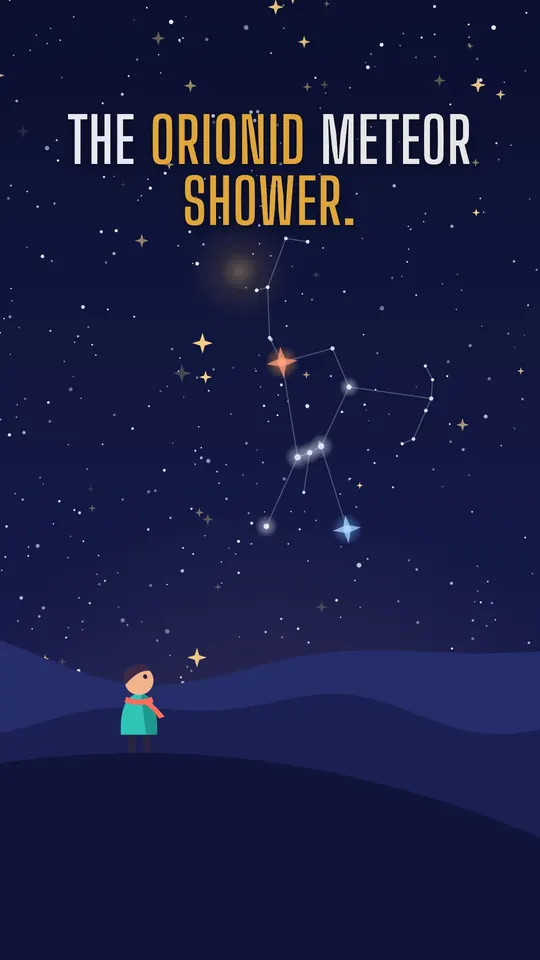
Watch the Orionids for a while and you'll notice their trails point back toward one patch of sky. That spot is called the radiant. This one lies just north of Betelgeuse, the bright reddish star at Orion's shoulder, near the Hunter's raised club. That's where the name comes from.
The meteors don't come from Orion. Its stars are unimaginably far away; the dust is about 100 kilometres up. The grains are all travelling along nearly parallel paths, and perspective makes parallel lines seem to meet, the way railway tracks converge in the distance.
That leads to the best practical tip in this piece: don't stare at Orion. Meteors near the radiant come almost straight at you and look short. Look 45 to 90 degrees away from it and the same meteors draw longer trails.
Every Orionid travels in parallel. Perspective draws them back to one point.

Orionid meteor shower 2026: peak date and viewing times
When is the Orionid meteor shower 2026 peak date?
The Orionids are active from October 2 to November 7, 2026. The night that matters is October 21–22.
The predicted peak is 18:00 UTC on October 21, which is mid-afternoon in New York. That's less of a problem than it sounds. The Orionid maximum is broad and flat, holding near its best for several nights, so the mornings either side of the peak are worth trying too.
When is the meteor shower tonight?
Searching that on October 4 gets you an honest "not yet." The Orionids have started, but they're a slow build. Circle October 21–22, 2026, and plan on the last few hours before dawn.
Orionid meteor shower 2026 viewing times
The Moon is the one complication this year. On the peak night it's waxing gibbous, about three-quarters lit, and bright enough to wash out fainter meteors. Full Moon follows on October 26.
The good news: the Moon sets a few hours before dawn, leaving a dark window.
- New York: the Moon sets at 3:13 a.m. EDT on October 22. Sunrise is 7:15 a.m.
- London: the Moon sets at 2:50 a.m. BST on October 22. Sunrise is 7:36 a.m.
A night earlier, the Moon sets about an hour sooner (2:07 a.m. in New York, 1:34 a.m. in London), so October 20–21 gives you a longer dark stretch on the shoulder of the peak.
Orion rises before midnight, so by the time the Moon is down, the radiant is well up. Go out after moonset and stay until the sky starts to brighten. Elsewhere, look up your local moonset time; the pattern holds.
Where can you see the Orionid meteor shower?
From almost anywhere on Earth. The Orionids are visible from both the Northern and Southern Hemispheres in the hours after midnight.
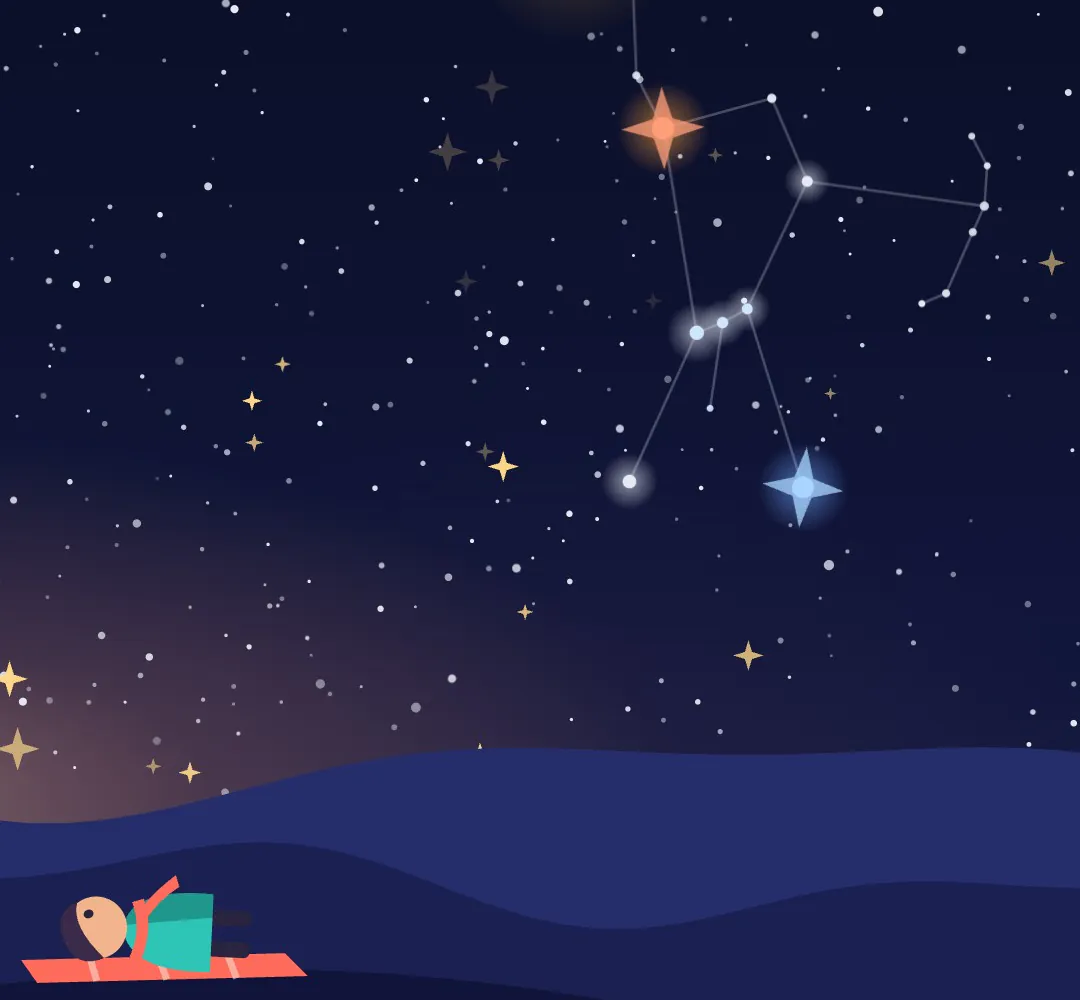
In the north, lie back with your feet toward the southeast. In the south, face your feet northeast. Then look up and take in as much sky as you can.
What is the best place to see the Orionid meteor shower?
The darkest place you can safely get to. Every streetlight you leave behind adds meteors to your count.
No telescope or binoculars. They narrow your view to a sliver, and meteors can appear anywhere. Your eyes are the right instrument.
Give them time. In under 30 minutes in the dark, your eyes adapt and fainter meteors start to show. Every look at a bright phone screen sets that clock back.
Bring a blanket or a reclining chair, and dress warmer than you think you need. Late October before dawn is colder than it sounds.
How many meteors will you actually see?
Here's the honest number. The International Meteor Organization gives the Orionids a rate of about 20 per hour. That figure assumes a perfectly dark sky with the radiant straight overhead, so treat it as a ceiling, not a promise.
NASA and the American Meteor Society both put a typical dark-sky count at 10 to 20 per hour. From a suburb, expect fewer. They also arrive unevenly: five minutes of nothing, then two in a row.
The Orionids have surprised people before. From 2006 to 2009, peak rates reached 50 to 75 per hour. Recent years have been low to average, so plan for a calm show and enjoy anything extra.
Treat 20 an hour as the ceiling, not the promise. One good streak is the point.
Go outside on October 21
Here's the whole plan. On the night of October 21–22, 2026, wait for the Moon to set. Get to the darkest sky you can reach, lie back, give your eyes half an hour and look up, away from Orion.
Don't expect a storm. Under a dark sky, 10 to 20 an hour is a good result; from town, fewer. There will be long gaps. If you're lucky, one leaves a train that hangs there for a few seconds.
Each streak is a grain of dust that Halley's Comet shed on one of its earlier passes, hitting the air at 66 kilometres per second. The comet itself is past Neptune and won't come back near the Sun until 2061. You don't have to wait for it.
You may never see Halley's Comet. You can see a piece of it on October 21–22.