Saturn at opposition · 3 October 2026
Saturn Is at Its Brightest of 2026 on October 4. Here's What You'll Actually See
A golden dot by eye, rings in any small telescope, and ring ice that hides its own shadows.
Did Saturn's rings disappear?
On March 23, 2025, Saturn's rings disappeared from view.
Nothing had happened to them. Earth passed through the plane of the rings that day, so we were looking at them exactly edge-on, and a disc that thin almost vanishes when you see it from the side.
Nobody actually saw the moment. Saturn was almost directly beyond the Sun from our point of view, eleven days past the line-up, and lost in the glare. But through 2025, telescopes showed the rings as thin as they ever get.
So the answer to "did Saturn's rings disappear" is yes, from where we stand, and no, from where they stand. They were there the whole time. We were looking from exactly the wrong angle.
Nothing broke. We were looking from exactly the wrong angle.
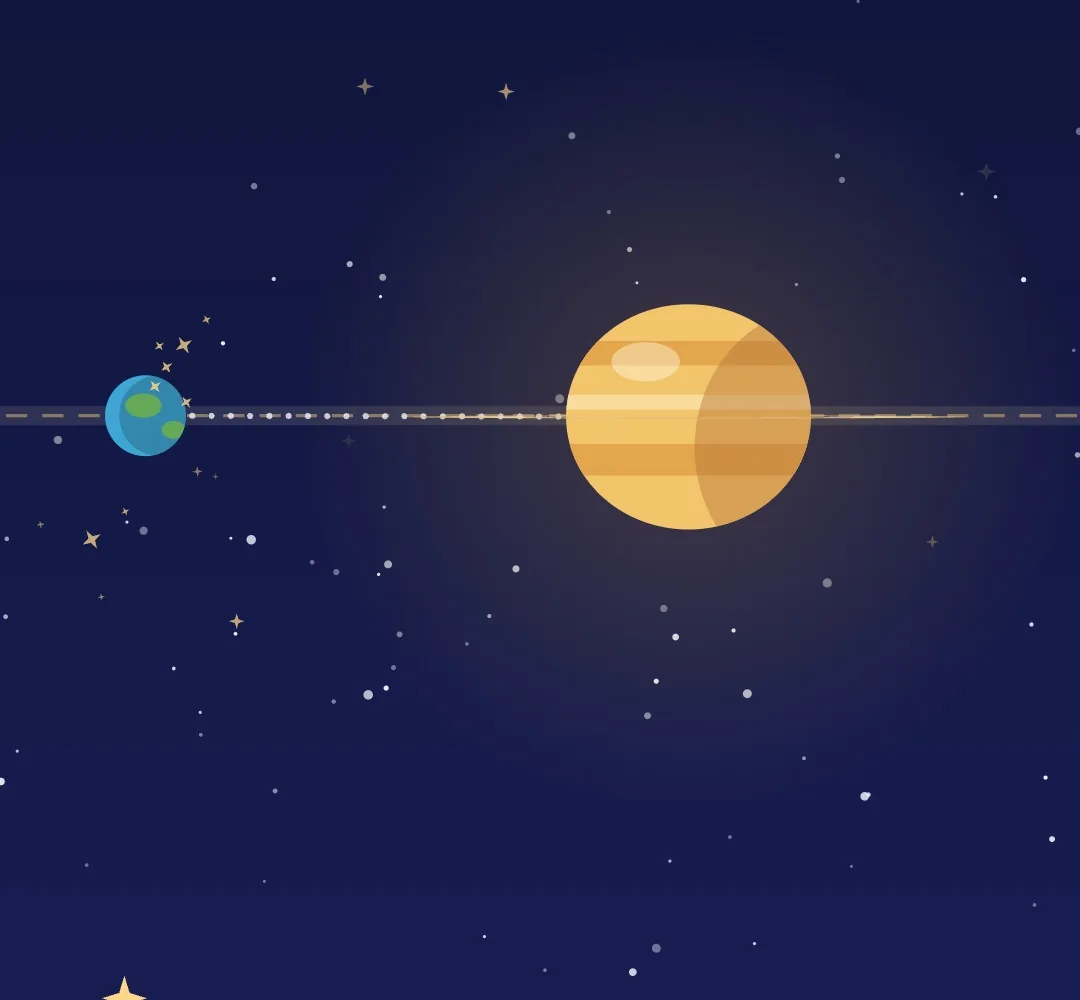
How thin are Saturn's rings?
The main rings are about 273,600 kilometres from edge to edge.
They are about ten metres thick. That's the typical figure; nowhere are they thicker than about a hundred.
Those two numbers don't sit comfortably together, so here is a scale model. Shrink the rings by a factor of 100,000, until they are as thick as a sheet of paper, a tenth of a millimetre. At that same scale, they would still be almost three kilometres across.
A sheet of paper three kilometres wide. Now hold it edge-on and step back 1.26 billion kilometres. Of course it vanishes.
Scaled down to the thickness of paper, the rings would still be almost three kilometres wide.
Galileo lost them too
This has happened before. The first person it happened to had no idea what he was looking at.
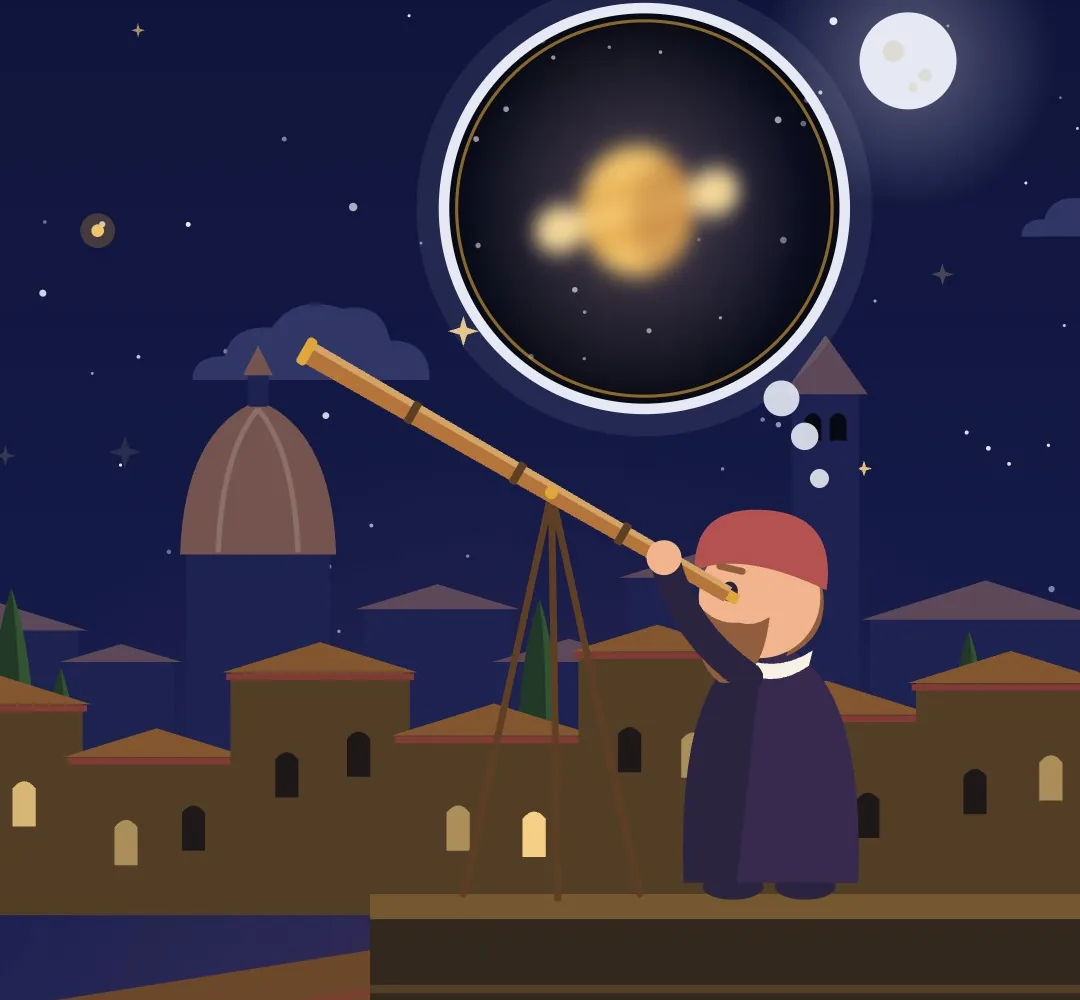
In 1610, Galileo turned his telescope on Saturn and saw something odd: the planet had two "ears," or attendants, one on each side. Then, in 1612, the attendants were simply gone. Earth had crossed the ring plane, exactly as it did in 2025. In 1613, they came back.
Nobody yet knew what they were. It was Christiaan Huygens, in 1655 and 1656, who worked out that Saturn wears a flat ring that doesn't touch the planet. He set it out in Systema Saturnium in 1659.
That is roughly forty years from the disappearance to the explanation. The rings never changed. Our angle did, and it took two generations of better lenses to understand it.
The rings never changed. Our angle did.
Why does Saturn have rings, and why do they tilt?
The honest answer to "why does Saturn have rings" is that how they formed is still argued over. What they are is settled. They are billions of chunks of ice and rock, from dust-sized grains to pieces as big as a house, orbiting in a thin sheet around Saturn's equator.
The tilting is easier. Saturn's axis leans 26.7 degrees, a little more than Earth's, and the rings lean with it. As Saturn makes its 29.4-year trip around the Sun, that lean stays pointed the same way in space. For roughly half of Saturn's year, we look down on the rings' northern face. For the other half, we look up at the southern one. Twice per orbit, every 13 to 15 years, we pass through the edge.
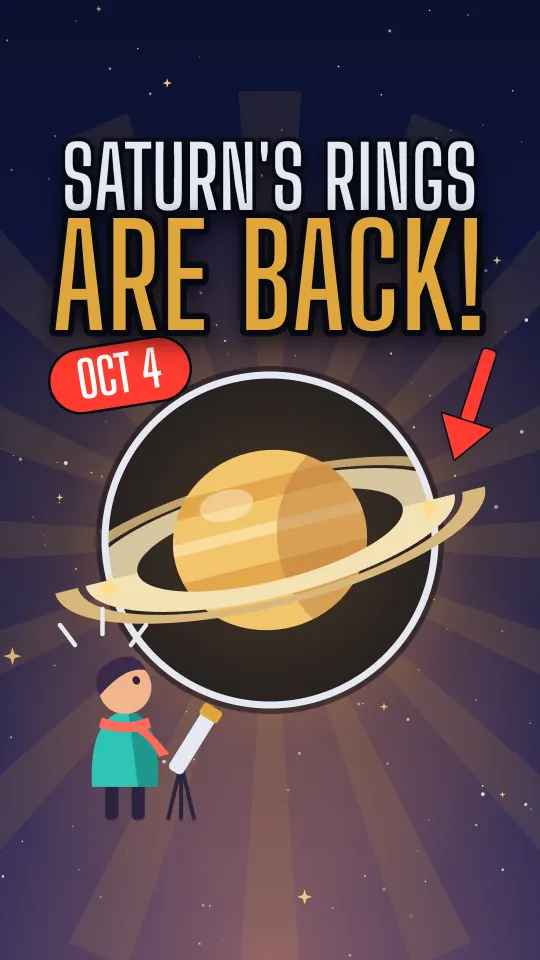
From 2009 to 2025 we saw the north face. The last time anyone on Earth saw the south face was before the crossing on September 4, 2009.
Now it's back. At opposition the rings are open by about 7.5 degrees, still narrow, and they will keep widening until around 2032.
For the first time since 2009, we're looking at the underside.
What is opposition?
Earth goes around the Sun once a year. Saturn takes 29.4 years. So Earth, on the inside track, keeps catching up and overtaking it, about once every 378 days.
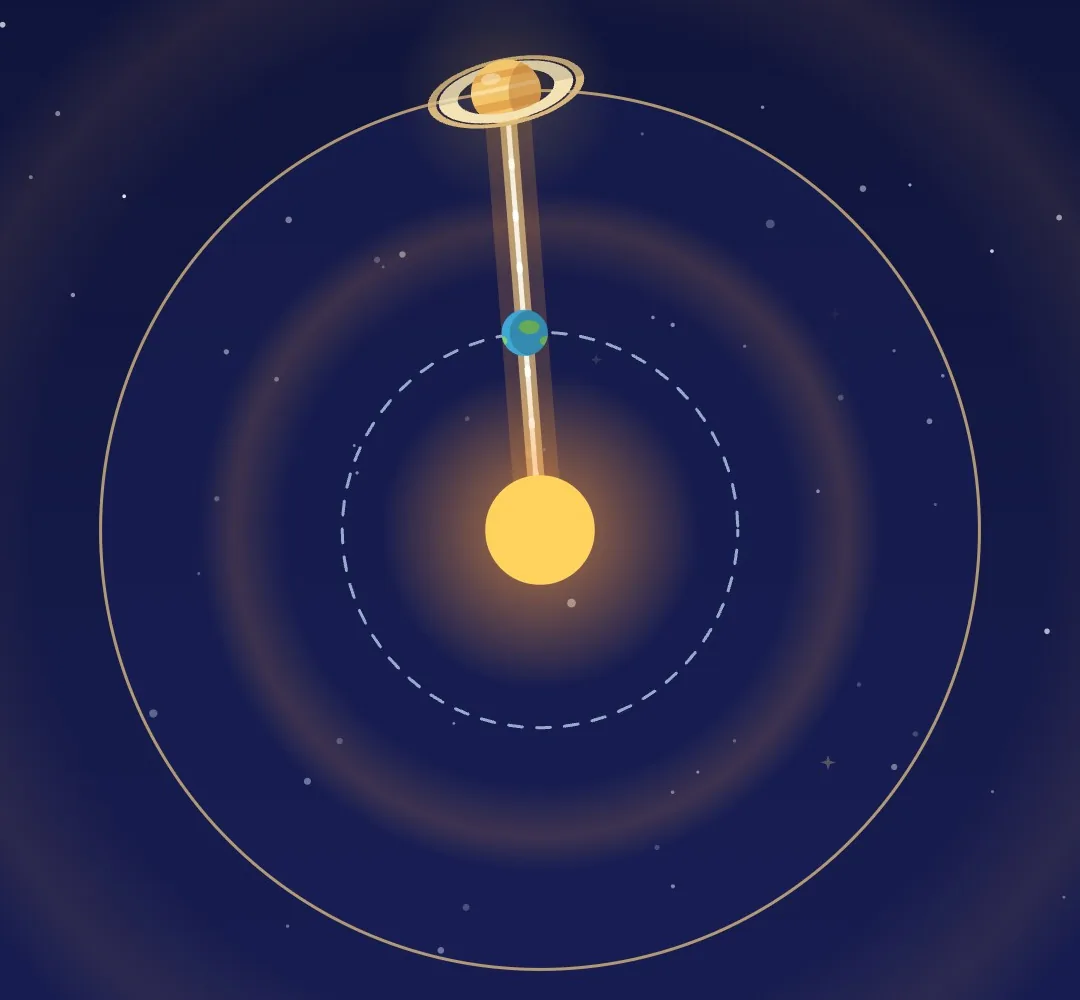
At the moment it overtakes, the Sun, Earth and Saturn line up, with us in the middle. Astronomers call that opposition, because Saturn sits opposite the Sun in our sky.
In 2026, that moment falls on October 4, around 12:00 UT (8 a.m. EDT).
Three things follow. Saturn rises as the Sun sets, stays up all night, and sets as the Sun rises. It is near its closest to us for the year. And it is at its brightest of 2026, magnitude +0.33, outshining all but a handful of stars.
At opposition, Saturn and the Sun trade places in the sky.
The opposition surge: ice that hides its own shadows
There is a second reason the date matters, and it's the best one.
On October 4, sunlight reaches Saturn from almost exactly behind us. The angle between the Sun's direction and ours, as seen from Saturn, is just 0.29 degrees.
Every ice particle in the rings casts a shadow. On most nights we see the rings from a slight angle, so some of those shadows are visible, and they dim the rings a little. At opposition, each shadow falls directly behind the particle that casts it, where we can't see it. With the shadows hidden, the rings brighten sharply.
It's called the opposition surge, or the Seeliger effect. You can see a mild version on Earth: stand with the Sun at your back and look at a gravel path. Every pebble hides its own shadow, and the path looks brighter than it does from the side.
The effect is strongest when the line-up is tightest, which is why the nights around October 4 are worth the effort.
At opposition, the ring ice hides its own shadows, and the rings flare brighter.
How far is Saturn from Earth?
On October 4, 2026, Saturn is 1.26 billion kilometres from Earth. That's about 783 million miles, or 8.43 times the average distance between Earth and the Sun.
Light crosses that gap in 70 minutes. Look at Saturn at 9 p.m. and you are seeing light that left it at about 7:50.
That light had already come a long way. It set out from the Sun about 78 minutes before it reached Saturn, which sits 9.4 times farther from the Sun than we do. Add the two legs and the light entering your eye left the Sun roughly two and a half hours earlier.
The Saturn you see is Saturn as it was seventy minutes ago.
The best time to see Saturn in 2026
The best nights are the ones closest to opposition: October 3 and October 4, 2026, and the rest of that week. But Saturn stays excellent through October and November, so a cloudy weekend costs you very little.
The Moon helps this year. It was at last quarter on October 3, so on the night of October 4 it doesn't rise until after midnight (about 1:10 a.m. EDT from New York). New Moon follows on October 10. The evening sky in early October 2026 is dark.
Where is Saturn right now?
Saturn is in Cetus, a big, faint constellation with no bright stars to compete with. Saturn is the brightest thing in that part of the sky.
Seen from New York on October 4, Saturn rises about 6:40 p.m. EDT, almost due east, just after sunset. It climbs to its highest, a little more than halfway up the southern sky, at around 12:50 a.m., then sets in the west around sunrise. If you live at a similar latitude, your times will be close. The pattern is the same everywhere: up at dusk, down at dawn.
Saturn sits almost on the celestial equator this year, so the view works from both hemispheres. From the south, it climbs into the northern sky instead.
How to see Saturn without a telescope
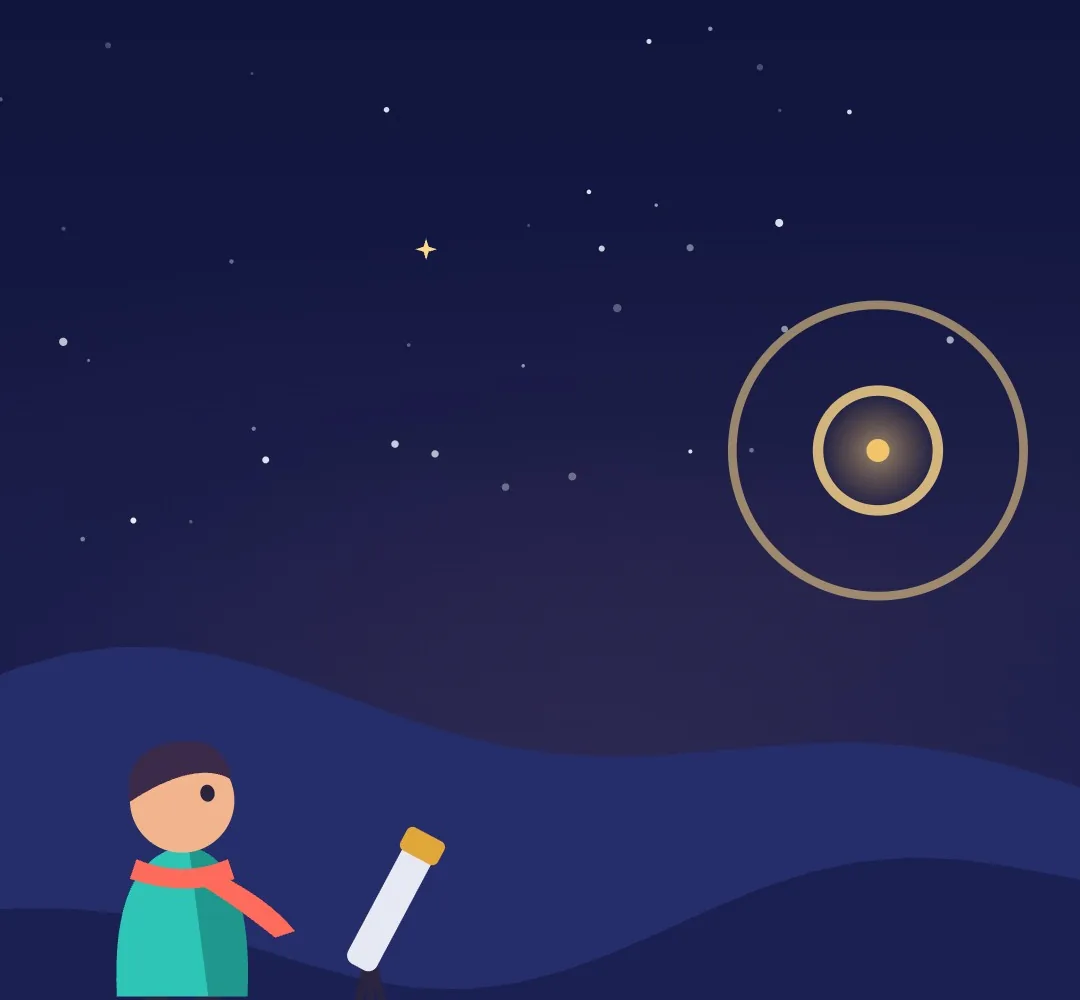
Give the sky an hour after sunset, then look east, low over the horizon. You're looking for a steady, golden dot. Stars twinkle; Saturn mostly shines steadily, as planets tend to do.
So, can you see Saturn tonight with nothing but your eyes? Yes, as that dot. That's all the naked eye gets. The rings are never visible without a telescope, at any point, in any year.
Binoculars make Saturn a slightly elongated blob at most, not rings. Don't expect more than that.
If you need help finding it later in the month, wait for October 23, when the Moon, a few days short of full, sits about 8 degrees from Saturn.
What a small telescope shows
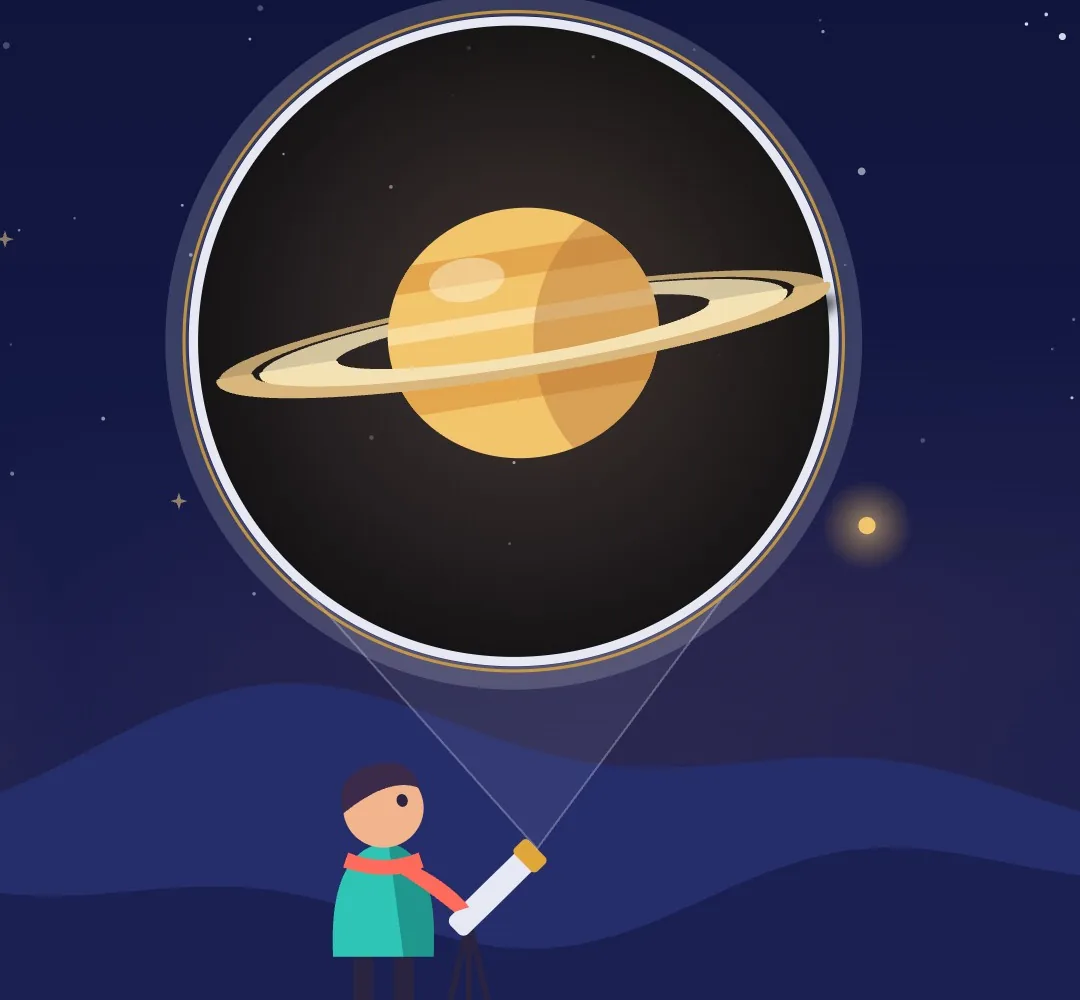
This is where the rings come back. Even the smallest telescope at 25x shows them. A 3-inch scope at 50x shows them standing clear of the planet on all sides, a thin tilted ellipse around a golden ball.
This year the ellipse is narrow, because the tilt is only about 7.5 degrees. That's part of the story: you're watching it open.
Look a little way off to one side for a faint star-like point. That's Titan, Saturn's largest moon, at magnitude 8.2, far too faint for the eye but easy in any telescope. On October 4 and 5 it is near its widest swing, about ten Saturn-widths from the planet. By October 12 it has moved to the other side.
The fainter moons Tethys, Dione and Rhea are within reach too, and they change position quickly.
One more planet hides nearby. Neptune is about 8 degrees west of Saturn, in Pisces. At magnitude 7.7 it's invisible to the eye and needs optics and a good finder chart.
How long it stays good
Saturn barely fades over the following weeks: from magnitude +0.33 at opposition to about +0.6 by the end of November.
What changes is the clock. By Halloween, it's highest around 11 p.m. By the end of November, it's already high in the south by 8 p.m., which suits anyone who would rather not stay up. The October 2026 night sky and the November one both belong to Saturn.
Is Saturn visible tonight?
If it's clear and the date is anywhere in October or November 2026, yes.
The plan for October 4, 2026 is simple. Go out about an hour after sunset, face east, and look low for a steady golden dot. That's Saturn.
Your eyes won't show the rings; no one has ever seen them without a telescope. Some of that dot's light is sunlight reflected from the ring ice, though, and around October 4 the rings return more of it than usual.
For the rings themselves, any small telescope at 25x will do. If you don't own one, ask a local astronomy club or a friend who does.
Galileo waited a year for the rings to come back. This time they're already back, and they'll open a little wider every year until about 2032.
No one has ever seen Saturn's rings without a telescope. Around October 4, 2026, a small one is all you need.