Why you'll only count six, the theory that the story is 100,000 years old, and where on Earth the stars actually vanish.
What are the Seven Sisters?
They are called the Seven Sisters. Go outside on an October night, find them, and count. You will almost certainly get six.
That isn't a failure of your eyes. Most people with good eyesight see six. The name has been seven for thousands of years anyway, in culture after culture, and that mismatch is one of the better small mysteries in the sky.
The Seven Sisters are the Pleiades, a tight little knot of blue-white stars that looks, at first glance, like a smudge or a tiny dipper. The word is pronounced PLEE-uh-deez (PLY-uh-deez is also in the dictionaries). If you have ever noticed a misty patch of stars and wondered whether your glasses needed cleaning, it was probably them.
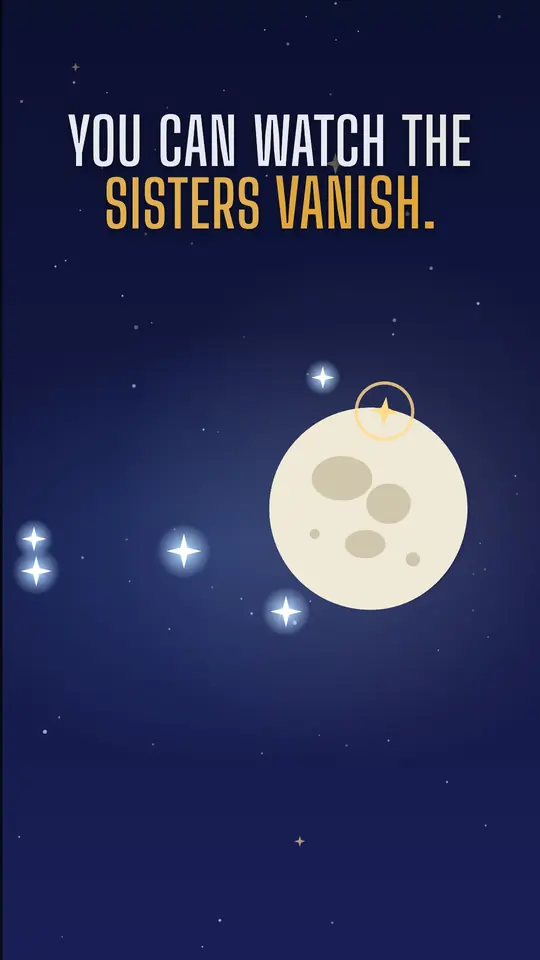
On the night of October 27–28, 2026, the Moon slides across them. From much of North America and almost all of Europe, some of the sisters will disappear behind it for a while. Everywhere else, the Moon passes close beside them.
They're called the Seven Sisters. You will count six.
Why do the Seven Sisters show only six?
The old stories noticed the missing star long before anyone had a telescope.
In the Greek version, the sisters are the daughters of the Titan Atlas and the sea nymph Pleione. Orion the hunter pursues them, and Zeus turns them into doves and then into stars to keep them safe. One sister, in a common telling, fell in love with a mortal and went into hiding, which is why only six are seen.
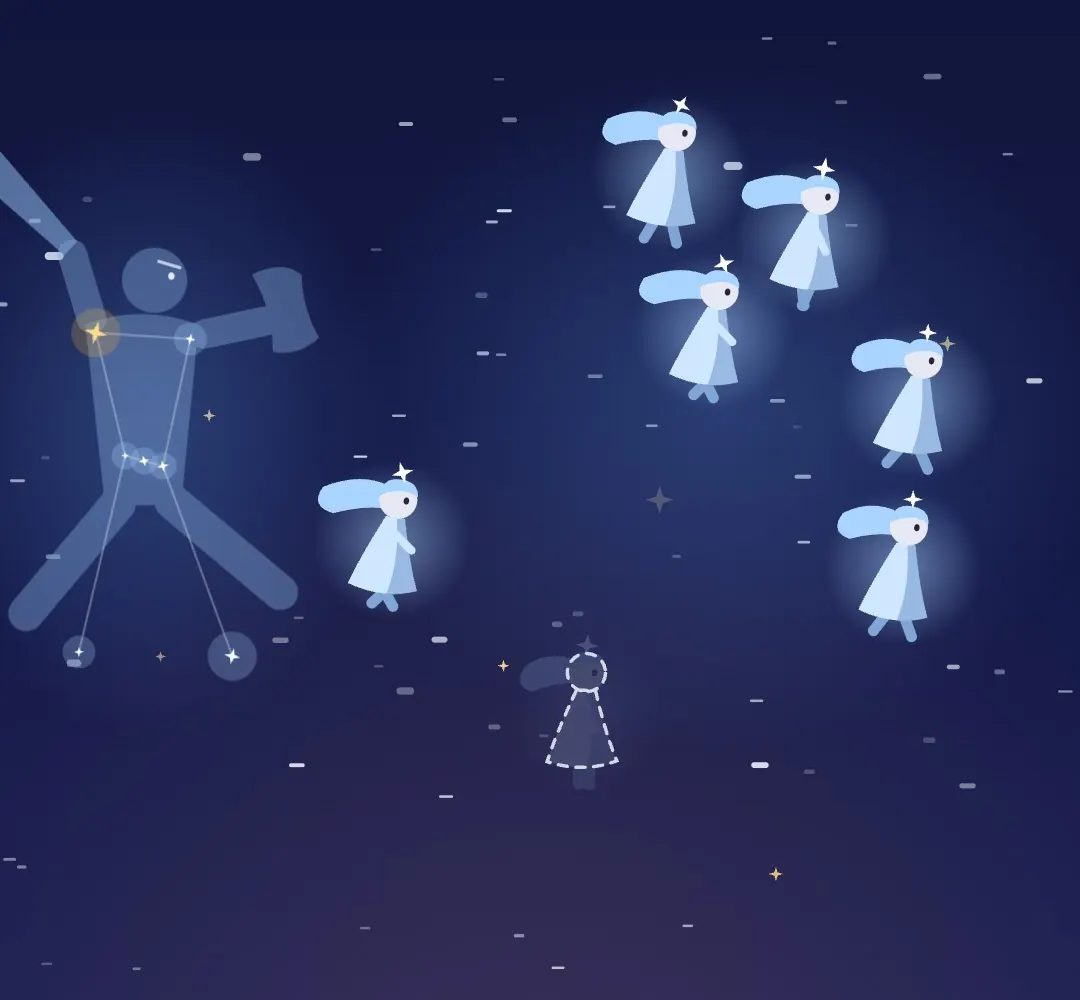
On the other side of the planet, many Aboriginal Australian peoples tell of the Pleiades as a group of young girls, tied to sacred women's ceremonies. The stars of Orion are often a hunter, or a group of young men, chasing them across the sky. And again, only six are visible: one sister has died, or is hiding, or is too young, or has been taken.
Ray Norris and Barnaby Norris, the researchers who set the two side by side in 2021, point out that the lost sister turns up well beyond Greece and Australia. There are versions in European, African, Asian, Indonesian, Native American and Aboriginal Australian cultures.
So people separated by oceans and tens of thousands of years agree on two odd details: there are seven, and one of them is missing.
Two cultures, a world apart, tell the same story: seven sisters, a hunter, and one gone missing.
A 100,000-year-old story?
What follows is a hypothesis, not a finding.
The stars of the Pleiades drift slowly relative to one another. Two of them, Atlas and Pleione, now sit so close that most eyes can't split them, and Pleione is lost in Atlas's glare. The Norrises ran the motions backwards. About 100,000 years ago, they found, Pleione sat far enough from Atlas to stand out on its own, and the cluster would have shown seven stars to the naked eye.
That date is also roughly when modern humans began leaving Africa. So the Norrises suggest that the story may already have been told before the migration, and travelled out with the people who carried it. Later, as Pleione slid into Atlas's light and the seventh star faded, the story would have needed a lost sister to explain the gap.
The names add an irony. In the Greek myth, Atlas and Pleione are the parents. On this theory, the parents have drifted together and hidden one of their daughters.
None of this is proven, and the authors present it as a possible explanation, not a result. If they're right, the Seven Sisters may be one of the oldest stories people still tell.
If the theory holds, this story walked out of Africa with us.
What is the Pleiades star cluster?
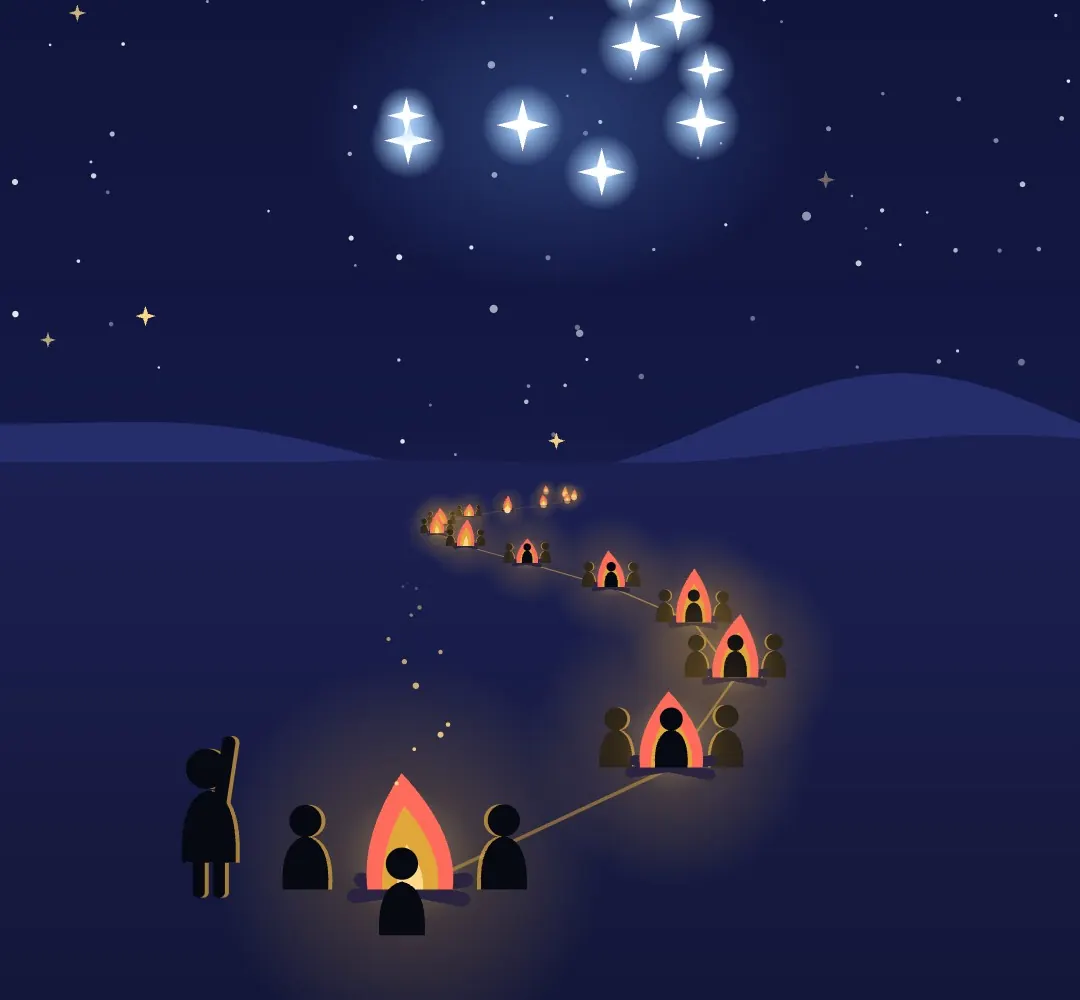
The Pleiades are a star cluster: stars born together from one cloud of gas, still moving through space as a group.
There are more than a thousand of them. Six are bright enough for most people to pick out unaided. The brightest are hot B-type stars, which give off a lot of blue light, so the cluster looks blue-white.
People often search for "the seven sisters constellation," but the sisters aren't a constellation. They are a cluster inside one, Taurus the Bull, about 444 light-years away.
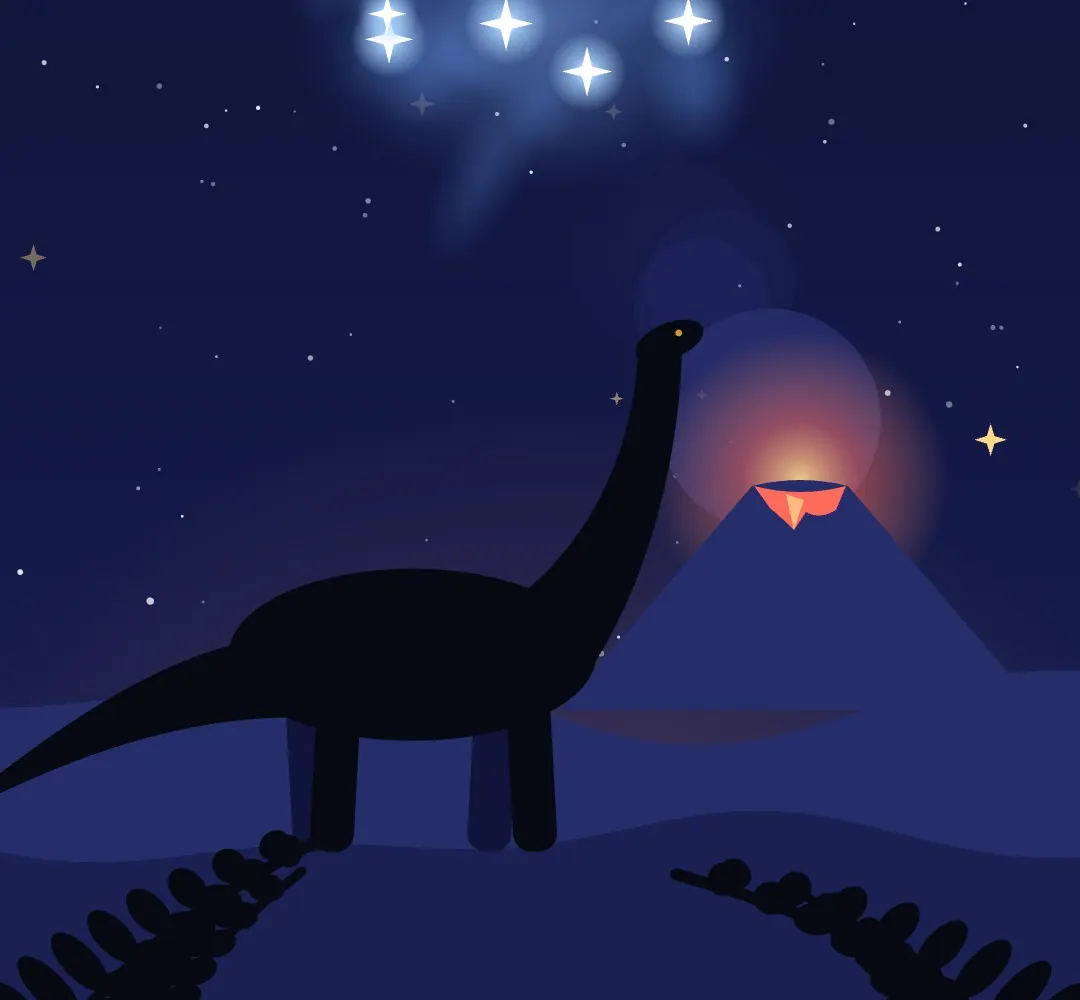
They are also young. The usual estimate is about 100 million years, and published figures run from roughly 75 to 125 million. Anywhere in that range puts the cluster's birth in the Cretaceous, while dinosaurs were still alive. The last of them died out 66 million years ago.
The stars of what may be our oldest story are younger than the dinosaurs.
The Moon and the Pleiades: a crossing every month until 2029
For years at a time, the Moon never touches the Pleiades. Right now, it crosses them every month.
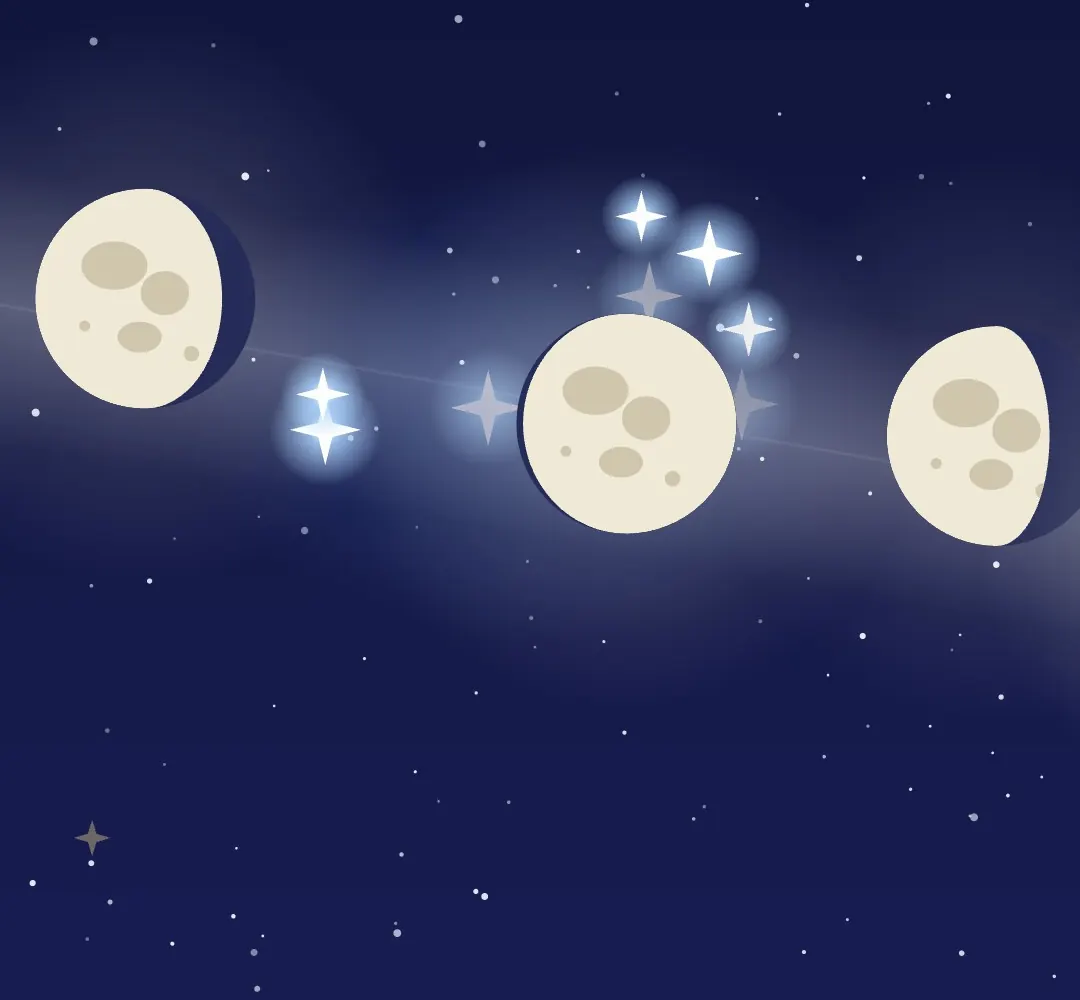
The Moon's orbit is tilted about five degrees to the path the Sun takes across our sky, and the direction of that tilt swings slowly around, over a cycle of 18.6 years. For part of the cycle, the Moon's monthly track runs straight through the Pleiades. For the rest, it misses them.
We are in one of those runs now. The Moon has been passing in front of Pleiades stars every month since September 2023, and the series ends in July 2029. After that, the Moon's path slides off the cluster again.
Every month brings a crossing, but each one is visible only from part of the Earth, and some happen in daylight for any given place. October 27–28, 2026 favours North America and Europe.
The Moon has been crossing the Pleiades every month since September 2023. The run ends in July 2029.
October 27–28, 2026: the Pleiades and Moon crossing
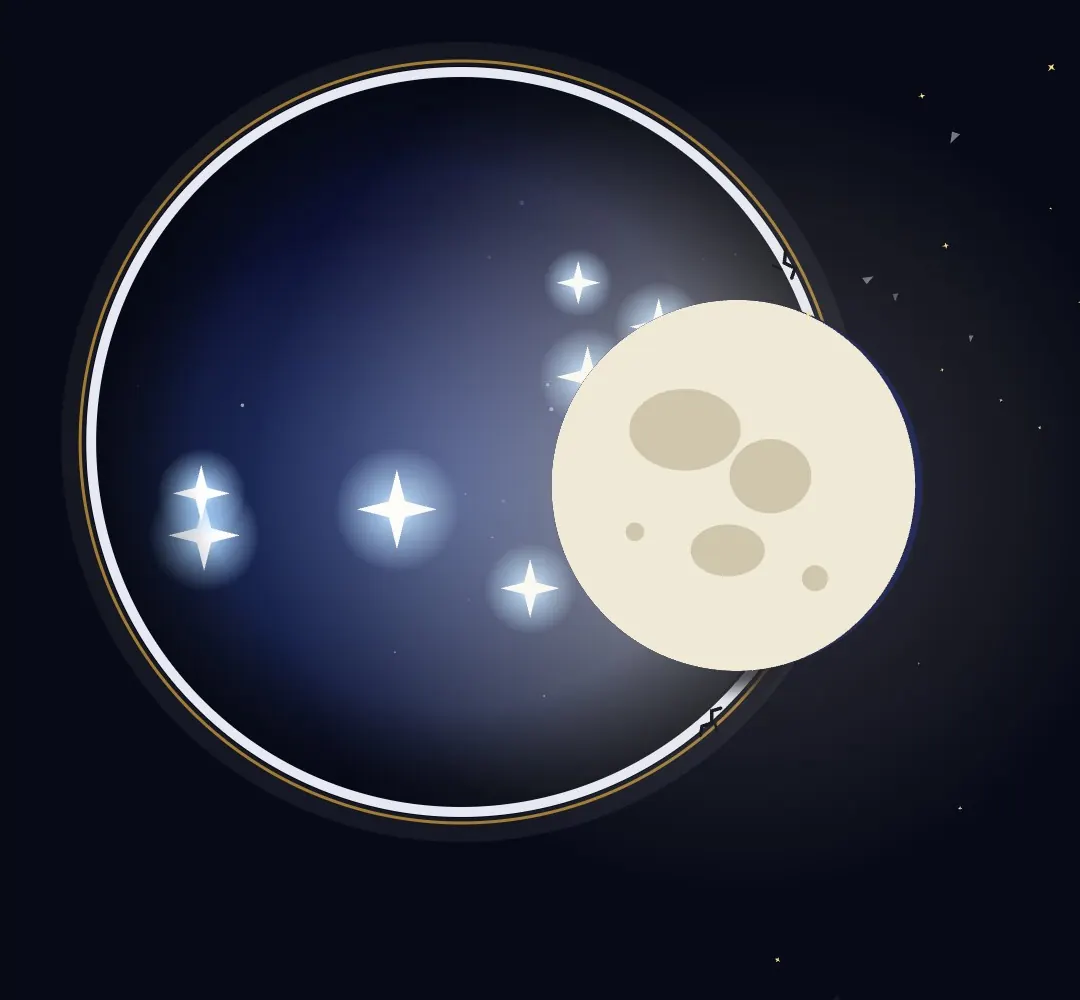
On the evening of October 27, 2026 in the Americas, and in the early hours of October 28 in Europe, the Moon moves across the Pleiades.
It arrives just past full. The Moon is full on October 26, and October's full Moon is traditionally called the Hunter's Moon. The night after the Hunter's Moon, the Moon goes after the sisters itself. That's a coincidence of names, not a plan, but it's a good one.
The catch is that an occultation (the word for one body hiding another) is a matter of where you stand. The Moon is close to us, so people in different places see it against slightly different patches of stars. We computed the event for 49 cities using NASA JPL's Horizons system and the positions of nine named Pleiades stars.
Where the stars vanish. Named Pleiades stars disappear behind the Moon from much of eastern and central North America, including New York, Toronto, Montreal, Chicago, Atlanta and Halifax, and from almost all of Europe, including London, Paris, Madrid, Lisbon, Berlin, Rome, Stockholm, Warsaw, Istanbul and Moscow. Iceland and Greenland see it too. From New York, five named stars go behind the Moon. Denver and Miami are on the fringe, with one star each, and only briefly.
Where it's a near miss. Everywhere else, the Moon passes close beside the cluster. For scale, the Moon is about half a degree wide, roughly 31 arcminutes.
- Athens: the Moon's edge misses the star Asterope by about a hundredth of the Moon's width.
- Dallas and Houston: a fifth of a Moon-width or less.
- Vancouver, Cairo, Havana, Dubai, Dakar and Seattle: roughly a fifth to a third of a Moon-width.
- Los Angeles, San Francisco and Phoenix: about one Moon-width.
- South America and India: roughly half a Moon-width to two.
- Africa: from a quarter of a Moon-width (Cairo) to two (Cape Town).
- East Asia: about four to six Moon-widths. Australia and New Zealand: about eight to ten.
Those are distances to the nearest named star. Fainter cluster members may still blink out in the near-miss zones, but the bright sisters stay put.
From New York and London, the sisters vanish. From Athens, the Moon misses by a hair.
Track 1 · eastern North America
How to watch: the honest version
You don't need a finder chart for this one. Find the Moon. The Pleiades are the small misty group right beside it.
Go out after dark and look east
In North America, the action is in the evening of October 27. In Europe, it's after midnight, in the early hours of October 28. The Moon rises in the east and climbs as the night goes on, so the later you go out, the higher it will be.
Bring binoculars
Here's the honest part. A Moon one day past full is enormous in its glare. It washes out the faint stars, and your eyes, adjusted to all that light, will struggle to see the cluster at all right up against it.
Binoculars help a great deal. They pull the brighter sisters out of the glow. A small telescope, if you have one, does better still.
Watch the bright edge
After full Moon, the Moon's lit side leads the way as it moves east among the stars. That means the stars disappear at the bright edge, where the glare is worst, so the vanishing is the hardest part to see. Watch a star sitting just off the lit edge. One moment it's there, and the next it simply isn't. There's no fade. The Moon has no air to dim the light first.
Each star stays hidden for anything up to an hour or so, depending on the star and where you are. Then it pops back out from the Moon's other edge, the dark one. On a Moon this full, that dark edge is only a thin sliver, but the reappearances there are easier to catch, because the glare is on the far side.
If you're outside the vanishing zone
You still get a fine view: a nearly full Moon parked beside the Seven Sisters. From Athens or Dallas, the Moon's edge will seem to graze the stars. Stay out for an hour and you'll see it shift against them: the Moon moves about its own width among the stars every hour.
One moment the star is there, the next it isn't. The Moon has no air to fade it out.
October 2026 night sky events
The Pleiades crossing closes out a crowded month. Saturn reaches opposition on October 4. The Draconid meteor shower peaks on October 8–9 and the Orionids on October 21–22. The Hunter's Moon is full on October 26, and the Moon reaches the Pleiades the following night.
Count them.
Most eyes find six. The old stories say seven.
Six, or seven?
For most of us, the Seven Sisters will stay six. Pleione is still lost in Atlas's glare.
On October 27–28, 2026, from New York, Toronto, London or Paris, you can watch the Moon take some of the sisters away one at a time, and hand them back from its far edge up to an hour or so later. From Athens, Dallas or Dubai, you can watch it come close.
Find the Moon after dark, bring binoculars, and count before and after.
On October 27, 2026, the Seven Sisters are six, and for part of the night, fewer.